Vanity Metrics vs. Actionable Metrics: A Guide for Early-Stage Founders

You spent hours on a LinkedIn post. Researching the hook, writing and rewriting every word, timing it perfectly. You hit publish and step away. You refresh a few hours later and the numbers are climbing. Likes, reposts, and a few comments from people in your network. By the end of the day, you've hit 500 views and 30 likes.
You screenshot it. You might even want to share it with your team.
But there are no new leads. No calls booked. No HR buyers in your DMs. Just a quiet pipeline that doesn't care how good your engagement looked yesterday.
Sound familiar?
Here's what no one tells early-stage founders: those numbers have a name, vanity metrics, and they're not the same thing as growth. In FamTech, ParentTech, and CareTech — where your buyer is a busy HR leader with a full inbox and a long vendor list — confusing the two isn't just frustrating; it's a problem, and it's costly.
What is a Vanity Metric?
Let’s take a step back and talk metrics. Specifically, vanity metrics.
Vanity metrics are data that appear impressive on paper, but aren’t a true indicator of ROI.
Many marketing metrics can appear as vanity metrics if they aren’t accompanied by strategic analysis.
Data like follower counts, likes and comments need to be paired with concrete stats like click-through rates and visitor-to-lead conversions to truly be meaningful.
The core distinction between vanity and actionable metrics is that vanity metrics make you feel good, while actionable metrics help you make decisions. If a metric doesn’t change how you act, it’s probably vanity.
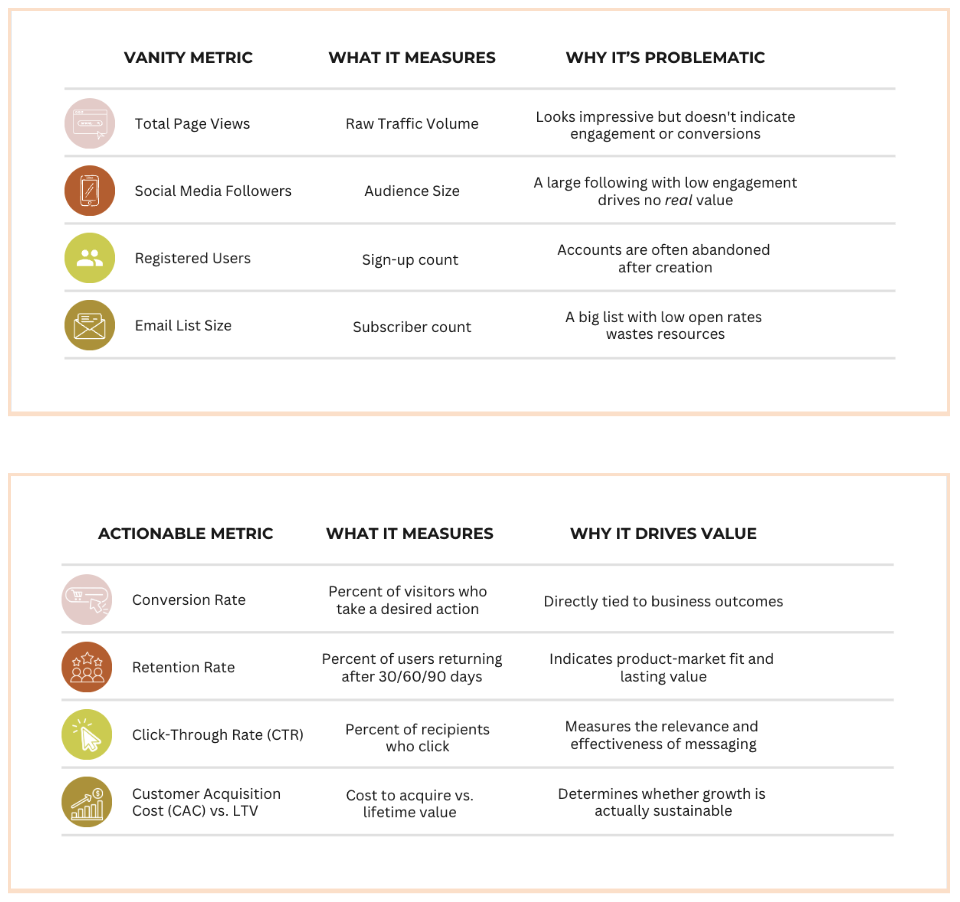
An easy way to remember the difference is that vanity metrics look good, but don’t predict outcome, while actionable metrics drive decisions and correlate with revenue.
The Vanity Metric Trap B2B Startup Founders Fall Into
In B2B marketing, who engages with your content matters more than the volume of engagement. Metrics only become meaningful KPIs when they map to real pipeline movement, not just applause from the wrong room.
And the risks are greater than you think.
That means your HR buyer has already Googled you, scrolled your LinkedIn, read your content, and formed an opinion long before you ever get a meeting. Your content isn't just marketing –– it’s your first sales conversation.
So if you're optimizing for reach without asking who you're reaching, you're essentially pitching to an empty room and calling it a win.
Good Numbers, Wrong Room. Here's How We Fixed It.
When we started getting intentional about our LinkedIn strategy, we were stuck in a pattern many founders know well — low engagement, quiet DMs, and a pipeline that wasn't moving. Our presence existed. It just wasn't working.
The fix wasn't to post more. It was to post for the right people.
By zeroing in on the specific titles, industries and decision-makers we actually needed to reach, everything shifted. Our follower count grew by 14.6% and engagement spiked by 229.3%. But here's the number that actually matters:
Over 17% of our audience are now founders, co-founders, CEOs, and owners.
That's not a vanity metric. That's a room full of buyers and collaborators who have a reason to care about what we’re building.
And that's exactly the work we do with our clients. Your engagement spike only means something because of who's driving it. Without that context, 229.3% is just a number that looks good in a screenshot — and screenshots can't close deals.
We don't just help you grow. We help you grow in the right room.
Stop Tracking Vanity Metrics in and Start Reaching the Right Audience
If you're an early-stage FamTech, ParentTech or CareTech founder trying to break through to HR buyers, the problem usually isn't your product. It's that your message isn't reaching the right room.
That's exactly what we fix.
Carter House Copy specializes in strategic messaging that connects you to the decision-makers who matter across every platform and every touchpoint. From pitch decks that make HR buyers lean in, to cold outreach that actually gets replied to, we build the marketing infrastructure that turns the right attention into real leads in the pipeline.
Because at the end of the day, vanity metrics are only worth celebrating when the right people are behind them.
Ready to stop guessing and start converting? Let's Talk.